
Advocacy · UN Road Safety Fund
Road safety must include what happens after the crash
At the UN Road Safety Fund Partnership Pledging Conference in New York, the G4 Alliance and the Global Coalition for Traumatic Brain Injury brought TBI, post-crash care, rehabilitation and measurable outcomes into the global road-safety agenda.
UN Road Safety Fund Partnership Pledging Conference · 20 July 2026 · UN Headquarters, New York
Road safety is often framed around preventing collisions. But for people who survive a crash, the story does not end when the collision is over — the minutes, hours, months and years that follow determine whether a person survives, develops preventable disability, or returns to family, work and community life.
That was the central message carried by the G4 Alliance and the Global Coalition for Traumatic Brain Injury at the UN Road Safety Fund Partnership Pledging Conference on 20 July 2026 at United Nations Headquarters in New York. Together, the two networks made a non-financial pledge to place their collective expertise behind the UN Road Safety Fund (UNRSF) and the Decade of Action for Road Safety through 2030.
The commitment brings a health-system perspective to road safety. It links crash prevention with the services needed when crashes occur: prehospital response, emergency and critical care, timely neurotrauma and operative care when required, rehabilitation, surveillance, long-term follow-up and the data needed to measure whether those systems are improving.
~75
G4 member organizations represented
50
Endorsing global organizations
16
Countries backing the proposed WHA TBI resolution
2030
Commitment horizon
A Commitment Through 2030
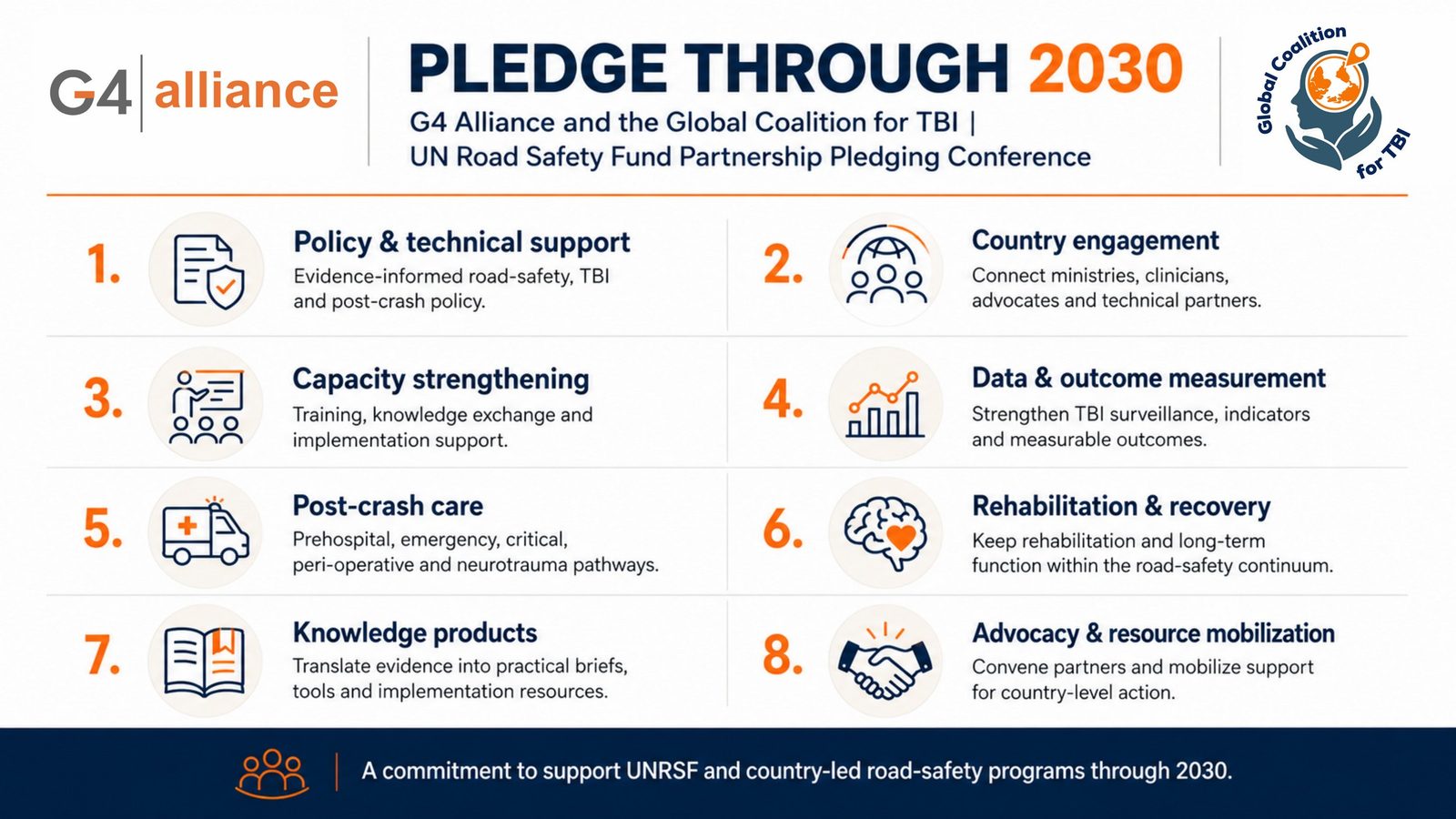
The pledge is deliberately practical. Rather than promising a single project or short-term campaign, the G4 Alliance and the Global Coalition for TBI committed to support country-led road-safety programs across eight connected areas.
The coalition statement was delivered on behalf of the networks by Natalie Draisin of the FIA Foundation. It positioned the contribution clearly: UNRSF provides a platform for implementation, while the two networks bring specialized post-crash expertise, global reach and Member State relationships that can help turn commitments into measurable action.
“We pledge to partner closely with the UN Road Safety Fund and country-led road-safety programs through 2030.”
The pledge at a glance
Eight areas of commitment
Together they create a bridge between global advocacy and practical country-level support through 2030.
01
Policy & technical support
Evidence-informed road-safety, TBI and post-crash policy.
02
Country engagement
Connect ministries, clinicians, advocates and technical partners.
03
Capacity strengthening
Training, knowledge exchange and implementation support.
04
Data & outcome measurement
Strengthen TBI surveillance, indicators and measurable outcomes.
05
Post-crash care
Prehospital, emergency, critical, peri-operative and neurotrauma pathways.
06
Rehabilitation & recovery
Keep rehabilitation and long-term function within the road-safety continuum.
07
Knowledge products
Translate evidence into practical briefs, tools and implementation resources.
08
Advocacy & resource mobilization
Convene partners and mobilize support for country-level action.
Why Post-Crash Care Belongs in Road Safety
Prevention remains the first goal. Yet even the strongest road-safety system must be prepared for the crashes that still occur. That is why the post-crash response is one of the core pillars of global road-safety action, and why trauma systems, emergency care, peri-operative services and rehabilitation matter to road-safety outcomes.
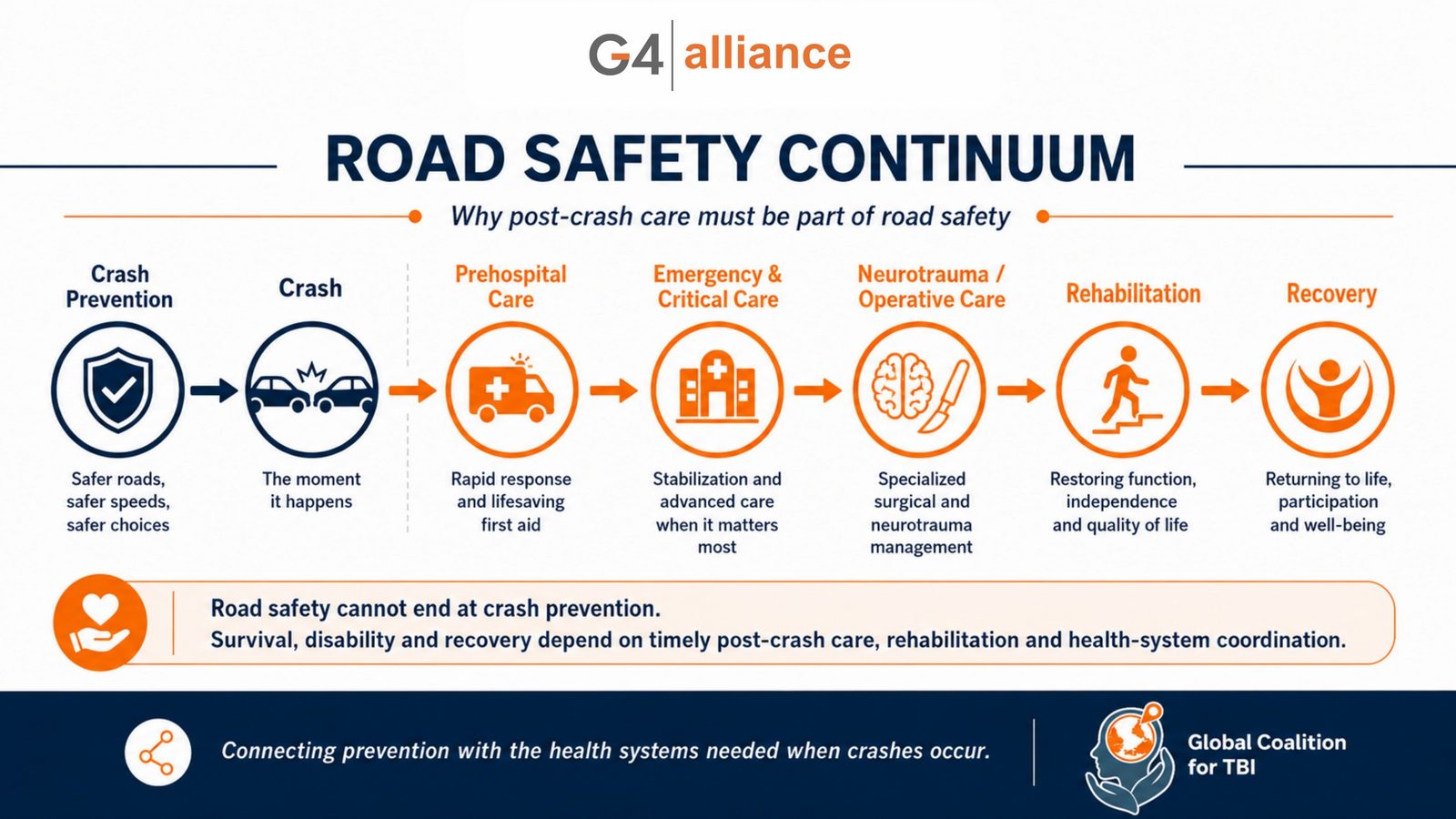
The clinical pathway is not a series of isolated services. A delayed ambulance response can affect what is possible in the emergency department. Inadequate resuscitation can worsen neurological injury. Delays in neurotrauma or operative care can change survival and disability. Without rehabilitation, a patient who survives may never recover function that could have been restored.
This is where the G4 Alliance adds complementary value. Its network spans surgical, obstetric, trauma and anesthesia care, with approximately 75 organizations represented across the broader SOTA community. The Global Coalition for TBI adds focused expertise in brain injury, rehabilitation, research, advocacy and lived experience — supported by 50 endorsing global organizations and 16 countries backing its proposed World Health Assembly resolution recognizing TBI as a preventable, notifiable and chronic condition.
From Pledge to Global Commitment
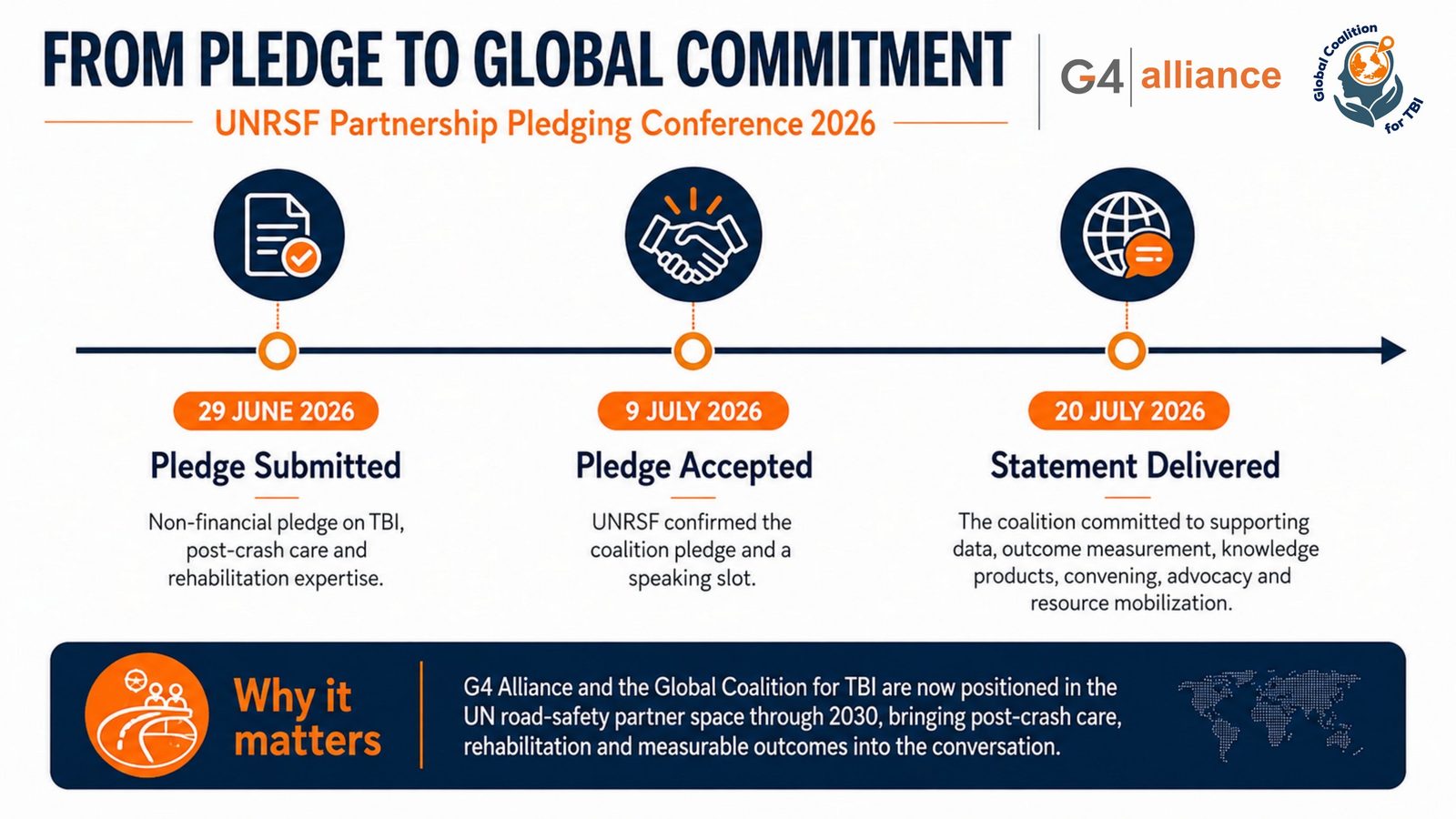
The July announcement followed a short but important sequence of formal steps: the coalition submitted its non-financial pledge on 29 June 2026, received confirmation of acceptance and a speaking slot on 9 July, and delivered the statement at the Partnership Pledging Conference on 20 July.
- 29 June 2026
Pledge submitted
A non-financial pledge offering TBI, post-crash care and rehabilitation expertise.
- 9 July 2026
Pledge accepted
UNRSF confirmed the coalition pledge and a speaking slot at the conference.
- 20 July 2026
Statement delivered
The coalition committed to data, outcome measurement, knowledge products, convening, advocacy and resource mobilization.
The pledge focuses on contribution rather than ownership. The G4 Alliance and the Global Coalition for TBI are not replacing national road-safety programs or the mandate of UN institutions. Their role is to support, connect and strengthen existing efforts with expertise that is especially relevant to post-crash care, health-system performance, outcome measurement and recovery.
That distinction matters. Road safety is multisectoral by design. Transport, infrastructure, legislation, vehicle standards and public behavior all matter. So do the clinical systems that respond when prevention fails. By participating in the UNRSF partner space, the coalition can help ensure the fifth pillar — post-crash response — is understood not simply as transport from the roadside, but as a continuum of coordinated care.
A Global Platform With Broader Health-System Value
The value of the commitment extends beyond traumatic brain injury alone. TBI is a powerful entry point because road crashes are a major cause of severe brain injury, but the systems required to treat those patients are the same systems that support many other injured and critically ill people. Stronger emergency care, trauma pathways, peri-operative capacity, referral systems, rehabilitation and outcome measurement strengthen health systems more broadly.
For the G4 Alliance, the commitment reinforces a core advocacy principle: surgical, obstetric, trauma and anesthesia care must be visible wherever global policy decisions shape access to emergency and essential care. For the Global Coalition for TBI, it creates an opportunity to connect prevention, acute management and long-term recovery within a single policy conversation.
What Comes Next
Through 2030, the pledge creates a framework for continued engagement with UNRSF, Member States and country-led road-safety programs. The practical work will be measured not by the number of statements issued, but by whether expertise reaches countries, whether data become more useful, whether care pathways improve, whether rehabilitation remains part of the agenda, and whether progress can be demonstrated in outcomes that matter to patients.
The challenge now is to convert a global commitment into local value: helping ministries and clinical teams work together, supporting evidence-informed policy, strengthening implementation capacity, improving surveillance and outcome measurement, and keeping recovery visible long after the immediate crisis of a crash has passed.
From Global Commitments to Lives Saved
The July 2026 pledge places the G4 Alliance and the Global Coalition for TBI in an important road-safety conversation at a time when the world is measuring progress toward the 2030 Decade of Action targets. Their contribution is specific: bring post-crash care, brain injury, rehabilitation and measurable health outcomes into a space where they can influence policy and implementation.
For every person who survives a road crash, that work matters. A safer road system should prevent as many crashes as possible. When a crash still occurs, it should also give every injured person the best possible chance to survive, recover and return to life.
“Let us measure progress not merely by prevented crashes, but by every person reached in time, every life saved, every disability averted, and every recovery sustained to its fullest.”
Companion resources
- Full statement — Statement on behalf of the G4 Alliance and the Global Coalition for Traumatic Brain Injury
- One-page brief — Road Safety Must Include Brain Injury
To request either resource, contact contact@theg4alliance.org.